The Tree Vision in Daniel 4:11-12

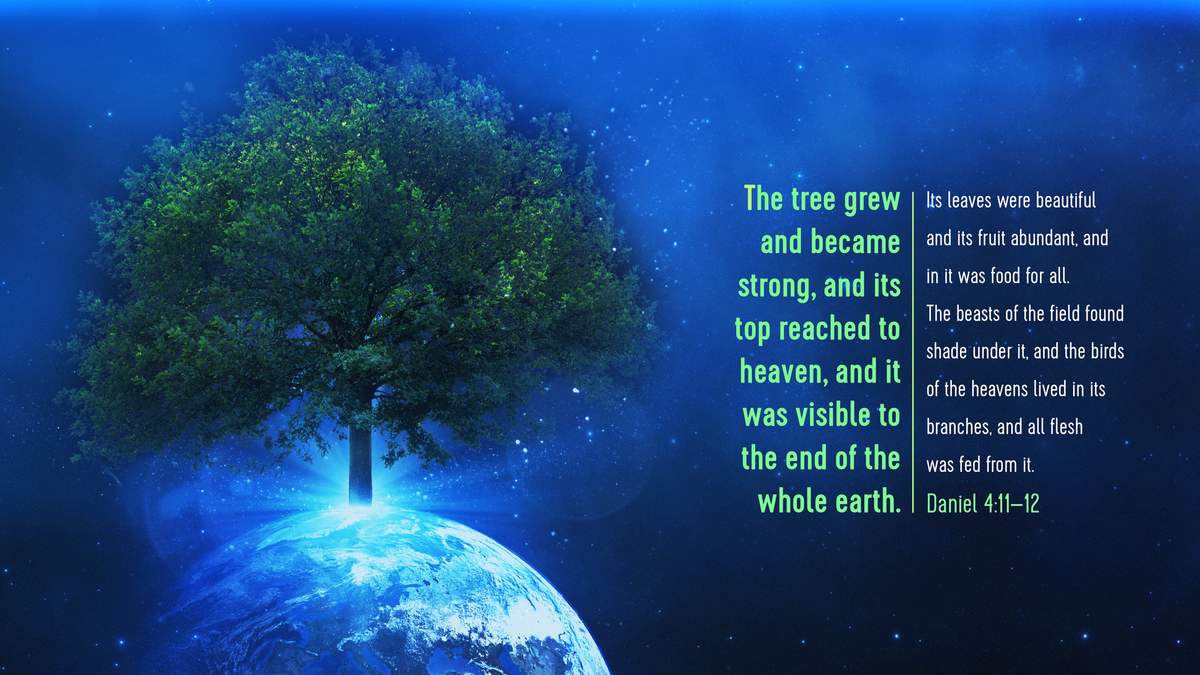
Today's verse from Logos is Daniel 4:11-12, The Book of Daniel, situated in the Old Testament, is a treasure trove of prophetic visions and dream interpretations. A central passage within this book is Daniel 4:11-12, wherein King Nebuchadnezzar shares a dream with Daniel that features an enormous tree. The English Standard Version (ESV) reads as follows:
"The tree grew and became strong, and its top reached heaven, and it was visible to the end of the whole earth. Its leaves were beautiful, and its fruit abundant, and in it was food for all. The beasts of the field found shade under it, and the birds of the heavens lived in its branches, and all flesh was fed from it."
To appreciate the depth of these verses, it's essential to understand the context. The Book of Daniel is set during the Babylonian exile when the Jews were taken captive by King Nebuchadnezzar of Babylon. Daniel, a Jew, served in the king's court due to his ability to interpret dreams.
In Daniel 4, Nebuchadnezzar recounts a dream to Daniel about a magnificent tree visible to the entire earth that eventually gets cut down at the command of a "holy watcher." The king is troubled by this dream and calls on Daniel to interpret it.
In the dream, the tree is described as tall, strong, and fruitful, providing for all creatures. This tree symbolizes Nebuchadnezzar, who had grown powerful and whose influence extended across many nations (Daniel 4:20-22). However, the subsequent felling of the tree signifies the humbling of the king due to his pride and arrogance.
The dream becomes a reality when Nebuchadnezzar has driven away from people and lives among the wild animals, humbled by God until he acknowledges the Most High's sovereignty (Daniel 4:32-33).
This passage offers profound insights into God's nature and His interaction with humankind.
- God's Sovereignty: This passage affirms the sovereignty of God. Just as the tree was visible to the whole earth, so was God's rule and reign. He is the one who allows leaders to rise to power and can also bring them down.
- God's Justice: The humbling of Nebuchadnezzar serves as a potent reminder that God opposes the proud but gives grace to the humble (James 4:6). God, in His justice, doesn't ignore the arrogance of those in power.
- God's Provision: The tree, with its abundant fruit and providing shade, symbolizes God's provision. It's a reminder of God's care and provision for all of His creation, mirroring the sentiment found in Matthew 6:26: "Look at the birds of the air; they do not sow or reap or store away in barns, and yet your heavenly Father feeds them."
- God's Mercy: Despite Nebuchadnezzar's pride and punishment, God restores him when he acknowledges God's sovereignty (Daniel 4:34-36). This shows God's mercy and His willingness to restore those who repent.
Daniel 4:11-12 serves as a stark reminder of God's far-reaching sovereignty, justice, provision, and mercy. It calls Christians to humility, reminding us that while human accomplishments are significant, they are ultimately subject to the divine authority of God. It also comforts God's providence, knowing He cares for all of His creation and extends mercy to those who acknowledge His sovereignty.
In our contemporary society, where self-sufficiency and individualism are often celebrated, this passage provides a counter-narrative that re-centers God in our lives. It reminds us to honor God as the ultimate source of all authority, provision, and mercy and to live in a manner that reflects this acknowledgment.